Action Research

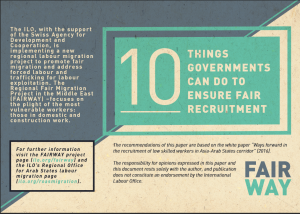
10 Things Governments Can Do to Ensure Fair Recruitment

The ILO, with the support of the Swiss Agency for Development and Cooperation, is implementing a new regional labour migration project to promote fair migration and address forced labour and trafficking for labour exploitation. The Regional Fair Migration Project in the Middle East (FAIRWAY) –focuses on the plight of the most vulnerable workers: those in […]

10 Things Governments Can Do to Ensure Fair Recruitment Read More »

Ways forward in recruitment of low-­skilled migrant workers in the Asia-­Arab states corridor

This White Paper serves to further stimulate policy dialogue for fair migration in the countries of origin and destination in Asia the Arab States corridor. Within the Asia-Arab States corridor, the ILO Regional Office for Arab States (ROAS) and the ILO Regional Office for Asia and the Pacific (ROAP) have collaborated with constituents to promote

Ways forward in recruitment of low-­skilled migrant workers in the Asia-­Arab states corridor Read More »

Recruitment experiences of South Asian migrant workers in Jordan’s garment industry

The rapid expansion of Jordan’s garment industry over the past two decades has been accompanied by a large increase in the industry’s migrant workforce. Accompanying this rise in the number of migrants, most of whom are from South Asia, has been the growing use of private employment agencies that specialize in recruiting workers in their

Recruitment experiences of South Asian migrant workers in Jordan’s garment industry Read More »

Good practices and provisions in multilateral and bilateral labour agreements and memoranda of understanding

Memoranda of understanding (MoUs) and bilateral labour agreements (BLAs) are important instruments between the countries of origin and countries of destination. They help regulate labour migration, protect migrant workers’ rights and guarantee conditions for decent work. The Government of Bangladesh has been developing bilateral relationships with countries in the Middle East and East Asia on

Good practices and provisions in multilateral and bilateral labour agreements and memoranda of understanding Read More »

Shortchanged: The Big Business Behind the Low Wage J-1 Au Pair Program

Every year, tens of thousands of internationally recruited au pairs come to the United States with the promise of a cultural exchange under the J-1 visa program. Instead, many encounter wage theft, discrimination and exploitation. “Shortchanged The Big Business Behind the Low Wage J-1 Au Pair Program” debunks the myth that the poorly regulated au

Shortchanged: The Big Business Behind the Low Wage J-1 Au Pair Program Read More »

Domestic Workers and Employers in the Arab States: Promising Practices and Innovative Models for a Productive Working Relationship

The domestic work sector in the Middle East is constantly evolving. No longer are domestic workers employed only to clean homes – modern households are increasingly expecting domestic workers to support the care of children during critical stages of development, aid the elderly to live with increased autonomy, and assist in chores and household management.

Domestic Workers and Employers in the Arab States: Promising Practices and Innovative Models for a Productive Working Relationship Read More »

Agents of Change? Assessing Hong Kong employment agencies’ compliance with the Code of Practice

“Agents of Change?” exposes how employment agencies in Hong Kong are failing to comply with the Hong Kong government’s Code of Practice for Employment Agencies leaving migrant domestic workers at risk of abuse and exploitation. The research was conducted by the Federation of Asian Domestic Workers Unions (FADWU). As of April 2018, there were nearly

Agents of Change? Assessing Hong Kong employment agencies’ compliance with the Code of Practice Read More »

Working Paper on Operational Parameters to Assess Fair Recruitment Practices

In South Asia, the pathways to jobs in domestic, garment or other similar sectors within the region or to the Middle East are intersected by various agents or contractors in an environment shaped by multiple rules and practices determining the mobility of aspiring workers especially women. The fluidity and segmentation of labour supply chains and

Working Paper on Operational Parameters to Assess Fair Recruitment Practices Read More »

Scroll to Top