rights

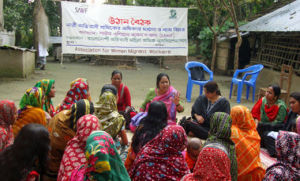
Migrant workers “shouldn’t have to be tortured to have work”

30 September 2014, People’s World Three times each month, dozens of women gather in dusty courtyards in rural towns in Manikganj, Dinazpur or other districts across Bangladesh to learn all they can about the only means by which they can support their families: migrating to another country for work. In leading these information sessions, the […]

Migrant workers “shouldn’t have to be tortured to have work” Read More »
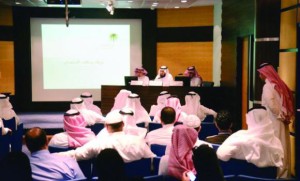
Ministry of Labor introduces company support program

31 August 2014, Arab News The Jeddah Chamber of Commerce and Industry (JCCI) organized a support program for businesses with the Labor Ministry on Thursday following the adoption of recruitment offices. The meeting took place in the presence of company owners, Abdul Mouneem Al-Sharhi, Labor Ministry branch manager in the Makkah region, Khalaf Al-Otaibi, JCCI

Ministry of Labor introduces company support program Read More »

“The Kafala System: When Employers Also Accepted to Share their Perspective”

Insan Association, Lebanon – July, 2014 INTRODUCTION Years ago the issue of Migrant Domestic Workers (MDWs) in Lebanon began to surface in international media. This came as a result of efforts by civil society organizations, including Insan Association, which have worked to shed the light on the multiple violations of Migrant Domestic Workers rights. Migrants

“The Kafala System: When Employers Also Accepted to Share their Perspective” Read More »

“Made in Canada: How the Law Constructs Migrant Workers’ Insecurity”

Fay Faraday, Metcalfe Foundation, September 2012 In the past decade, Canada’s labour market has undergone a significant shift to rely increasingly on migrant workers who come to Canada from around the globe on time-limited work permits to provide labour in an expanding range of industries. Since 2000, the number of migrant workers employed in Canada

“Made in Canada: How the Law Constructs Migrant Workers’ Insecurity” Read More »

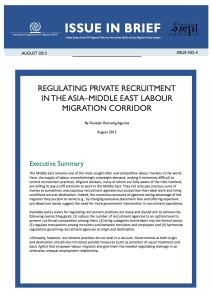
IOM & MPI Report: “Regulating Private Recruitment in the Asia-Middle East Labour Migration Corridor”

Dovelyn Rannveig Agunias, August 2012 The Middle East remains one of the most sought-after and competitive labour markets in the world. Here, the supply of labour overwhelmingly outweighs demand, making it extremely difficult to control recruitment practices. Migrant workers, many of whom are fully aware of the risks involved, are willing to pay a stiff

IOM & MPI Report: “Regulating Private Recruitment in the Asia-Middle East Labour Migration Corridor” Read More »

Scroll to Top