“Profiting from the Precarious: How Recruitment Practices Exploit Migrant Workers”

Fay Faraday, Metcalfe Foundation, April 2014 Over the past decade, Canadian employers have increasingly demanded access to a “flexible” workforce of transnational migrant workers. Canadian laws and policies have responded, speeding the flow of workers to Canada with precarious temporary immigration status. Since 2000, the population of temporary migrant workers in Canada has more than […]

“Profiting from the Precarious: How Recruitment Practices Exploit Migrant Workers” Read More »

Nurses’ experiences of recruitment and migration from developing countries: A phenomenological approach

Paul H. Troy, Laura A. Wyness, Eilish McAuliffe: Human Resources for Health 2007, 5:15 ABSTRACT Background: There is growing concern globally at the current flows of nurse migration, particularly from low-income to middle and high-income countries. Recruitment practices of many countries such as Ireland are thought to be fuelling this rate of migration. This paper

Nurses’ experiences of recruitment and migration from developing countries: A phenomenological approach Read More »

“Foreign Ministry’s help sought to solve Filipino recruitment issue”

25 June 2014, Arab News The Labor Ministry will approach the Foreign Affairs Ministry to sort out obstacles in recruiting Filipino domestic workers including contractual difficulties faced by Saudi recruiters in the Philippines. Labor Ministries of the two countries had signed an agreement earlier this year to resume recruitment of the Filipino domestic workers. Mufrej

“Foreign Ministry’s help sought to solve Filipino recruitment issue” Read More »

WHO: Global Code of Practice on the International Recruitment of Health Personnel

The WHO’s Code of Practice on the International Recruitment of Health Personnel aims to establish and promote voluntary principles and practices for the ethical international recruitment of health personnel and to facilitate the strengthening of health systems. Member States should discourage active recruitment of health personnel from developing countries facing critical shortages of health workers.

WHO: Global Code of Practice on the International Recruitment of Health Personnel Read More »

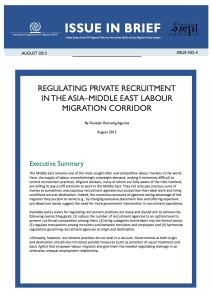
IOM & MPI Report: “Regulating Private Recruitment in the Asia-Middle East Labour Migration Corridor”

Dovelyn Rannveig Agunias, August 2012 The Middle East remains one of the most sought-after and competitive labour markets in the world. Here, the supply of labour overwhelmingly outweighs demand, making it extremely difficult to control recruitment practices. Migrant workers, many of whom are fully aware of the risks involved, are willing to pay a stiff

IOM & MPI Report: “Regulating Private Recruitment in the Asia-Middle East Labour Migration Corridor” Read More »

OECD & EC Report: “Immigration & Labour Shortages: Evaluation of Needs and Limits of Selection Policies in the Recruitment of Foreign Labour”

15474016.pdf Report by Marco Doudeijns & Jean-Christophe Dumont Brussels January 2003 This document presents the result of studies recently carried out in a range of OECD Member countries on labour shortages and the role that migration can play to alleviate labour shortages. In spite of the methodological problems, that may be involved in assessing labour

OECD & EC Report: “Immigration & Labour Shortages: Evaluation of Needs and Limits of Selection Policies in the Recruitment of Foreign Labour” Read More »

Scroll to Top